PA talks about tools used in Ace Combat 7's development – a translation of Famitsu's summary6/9/2019 Why yes buddy, as a matter of fact we are still alive. What a year it's been. A lot has happened since last time we've posted here. Some good. Some bad. Mostly bad. But hey, Ace Combat 7 came out! That's good, probably! The rest of the World News which the official site seemed to imply never materialized, so I'm afraid we haven't updated much lately. We're still watching just in case, but as it turns out, the next big thing came not from the official site but Famitsu in the form of an article summarizing a presentation Kosuke Itomi and Masahide Kitou gave at CEDC. If you'll recall, the official sites for a lot of classic Ace Combat games had production journals where the staff talked about how things were going and a bit about the production process itself. You'll also notice that we haven't translated these because, not being lore-related, they're not strictly within the scope of this site. I'd like to translate some of these eventually, but that's going to be a fuck-off huge amount of work for what is ultimately a side project. This presentation seems to cover some of the things that an Ace Combat 7 production journal might've touched on though, so I thought I'd translate the whole thing in full. 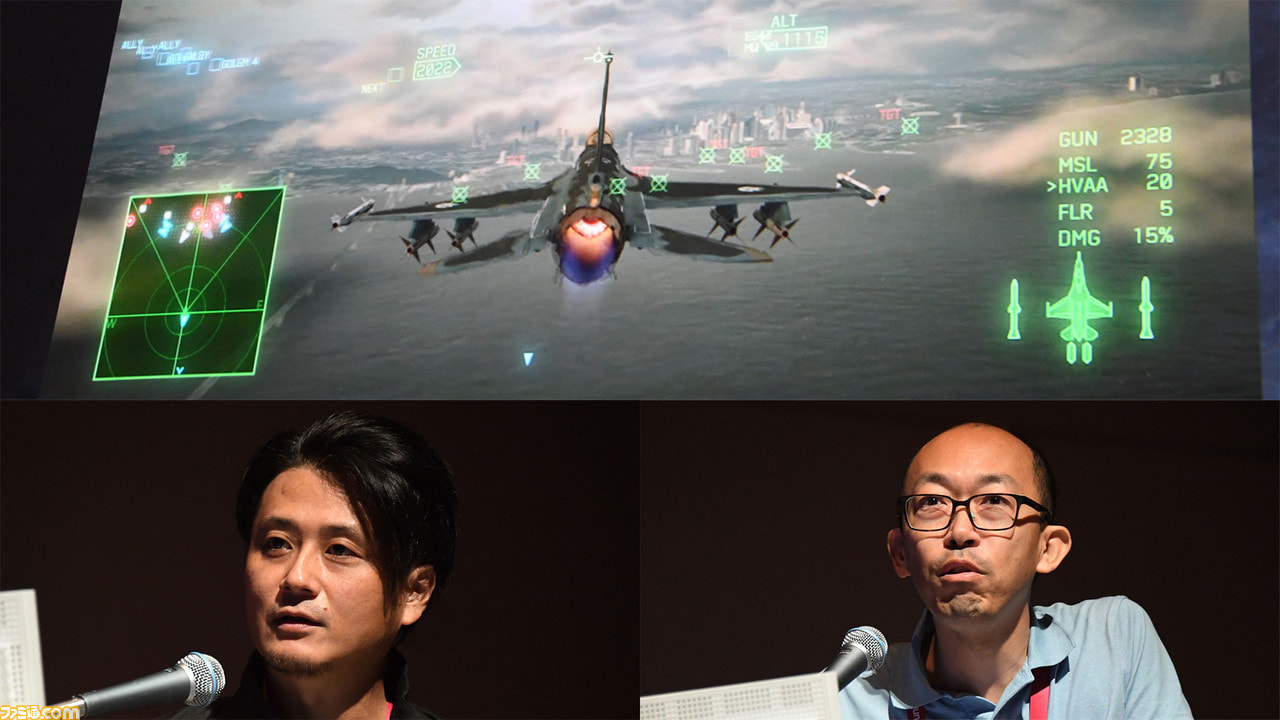 The secret of Ace Combat 7’s radio chatter!? Many innovations were made to merge gameplay and story! CEDC 2019 – the biggest conference in Japan aimed at computer entertainment announcements – was held between September 4th and 9th 2019 at the Pacific Convention Plaza in Yokohama. Here is our synopsis of the session “Sharing the kind of story we'd like to tell ~ the narrative production techniques of Ace Combat 7” which took place at the conference.  The role of a narrative director in improving the gameplay experience holistically, including story Ace Combat 7: Skies Unknown: a game by Bandai Namco Entertainment which connects rich worldbuilding with a story told through serious dialog exchanges. At this session, we were given an introduction to their storytelling techniques and to the innovations which they’d developed for themselves. Appearing on stage during the first half was Kosuke Itomi, who served at Bandai Namco Studio as narrative director on Ace Combat 7, and who has been involved with the Ace Combat series since 3. The discussion eventually came around to the topic of what Itomi’s role as narrative director was. A narrative director is in charge of planning out every element of the game’s direction and story. By “narrative” they don’t just mean he’s in charge of the “story,” but also all the related elements involved in storytelling like direction and music. To that end, his job ranges widely from setting down the general blueprint for production, to managing the story, conceptualizing the movies and music, and supervising the audio recording. He stands alongside planning and sound engineering staff related to these things, and improves the overall quality of the game experience. You might say he is the one who keeps everything related to the narrative on track. 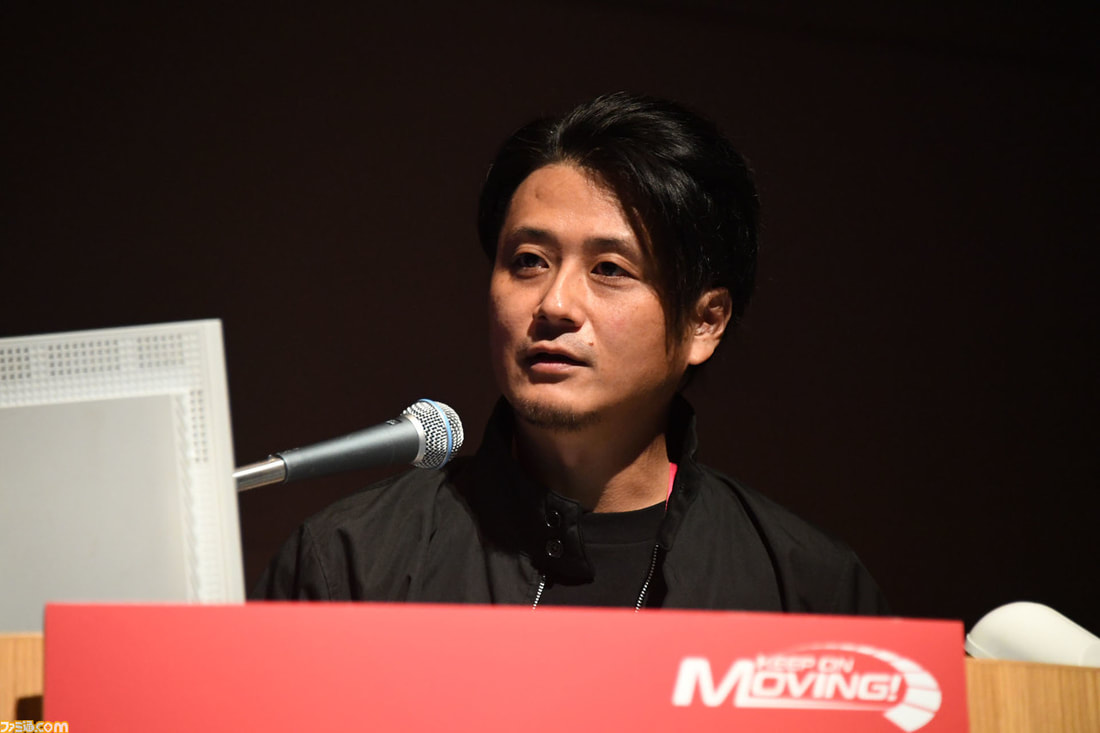 This scope is quite wide, and the tools which Itomi used in this key position include scene planning tables, “mission story,” and pre-visualization. The first of those – the scene planning tables – summarize the flow of the campaign mode from start to finish. It creates a large outline of the flow of the entire story. This is where the story’s flow and worldbuilding – and the basis for all the missions which stem from the story – are collated during initial stages of development. The specifications for each mission are decided upon during the mid stages of development and reflected here, as well as additional notes in the form of emails and minutes from meetings with anime screenwriter and director Sunao Katabuchi, who is in charge of the scripts. Further, in the final stages of development, a cue list (flags for starting and stopping) is added for the BGM – an inseparable part of the play experience. This is how the play experience is constructed. 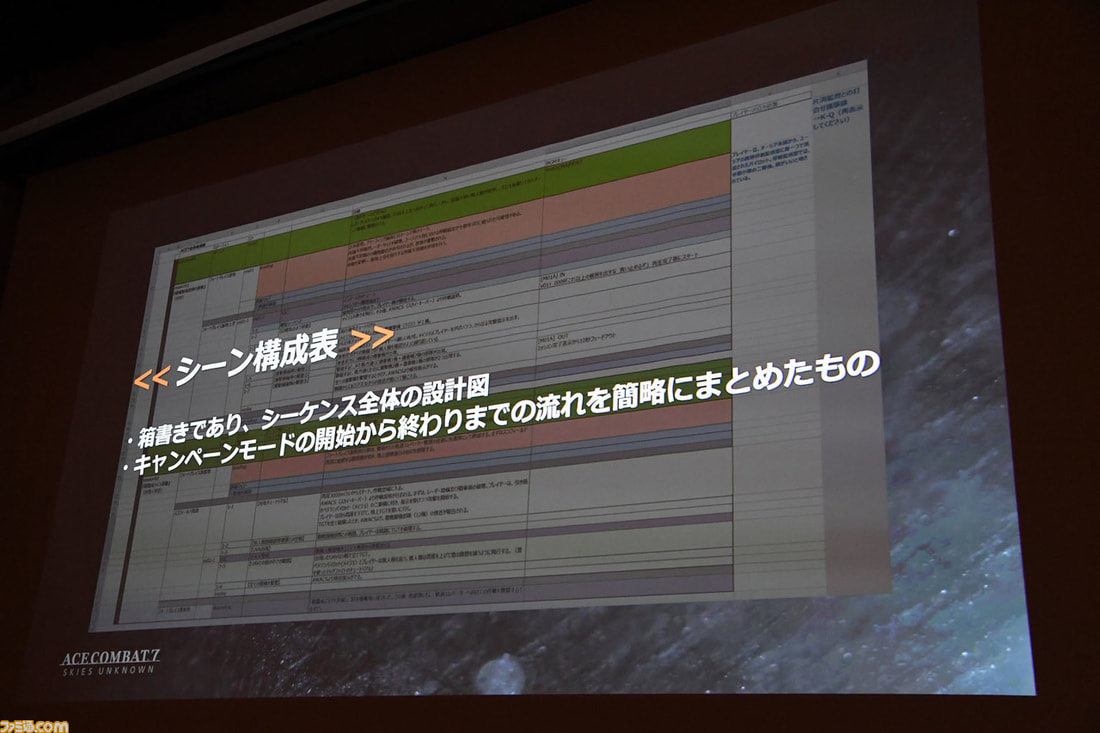 Scene Construction Table
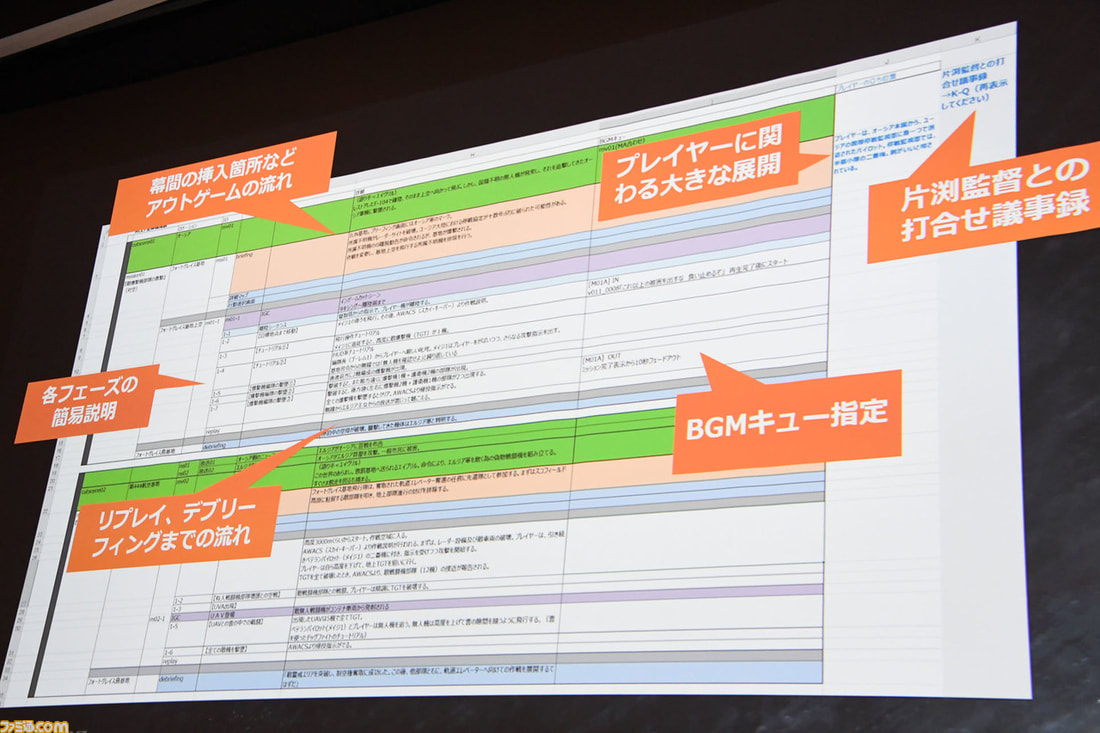 Top left to right:
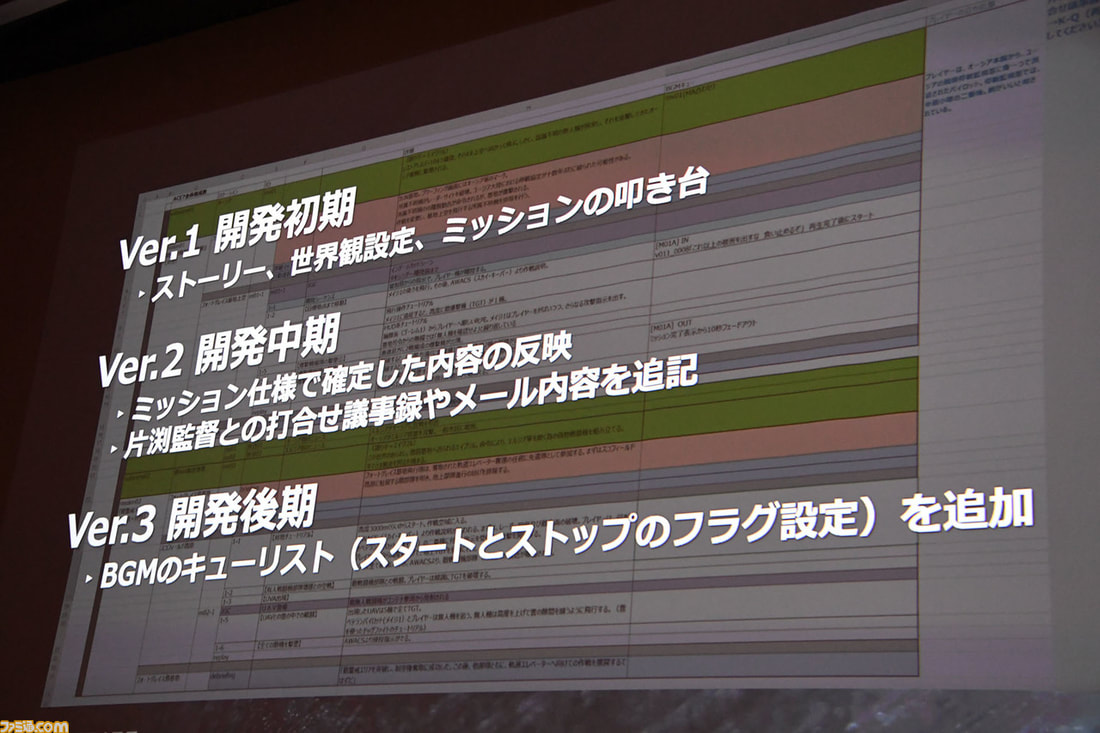 Ver.1 Initial Phase
The second tool, the “mission story,” is as the name implies, a collection of all the resources for any given mission in one place, with details about the story and gimmicks which unfold during the mission itself. By adding in the the in-mission script and appending time codes, the “mission story” is managed. As you might expect, many conversations take place between staff members while building the missions and story, and when there are scenes where the level design and story conflict and become out of balance, they work to pare down the dialog. This, among other things, makes it very easy for aberrations to develop which run counter to the original vision. To prevent this from happening, Itomi thought to create a backbone for the story. He took down Katabuchi’s answers to questions like “Why did you have this part like this? Why is this dialog important?” in emails and meetings for as long as her could, so that after the fact he could remember why things are the way they are. 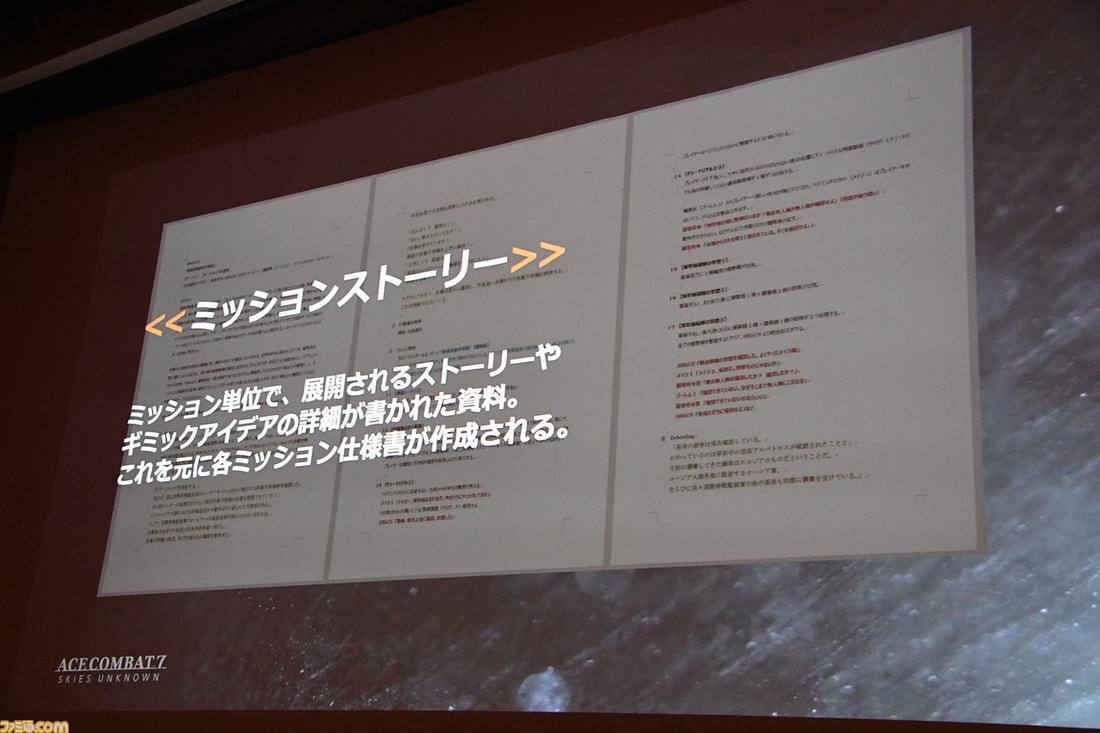 Mission Story A resource where the story and gimmick ideas for each mission are written down. Each mission specification sheet is created based on this. 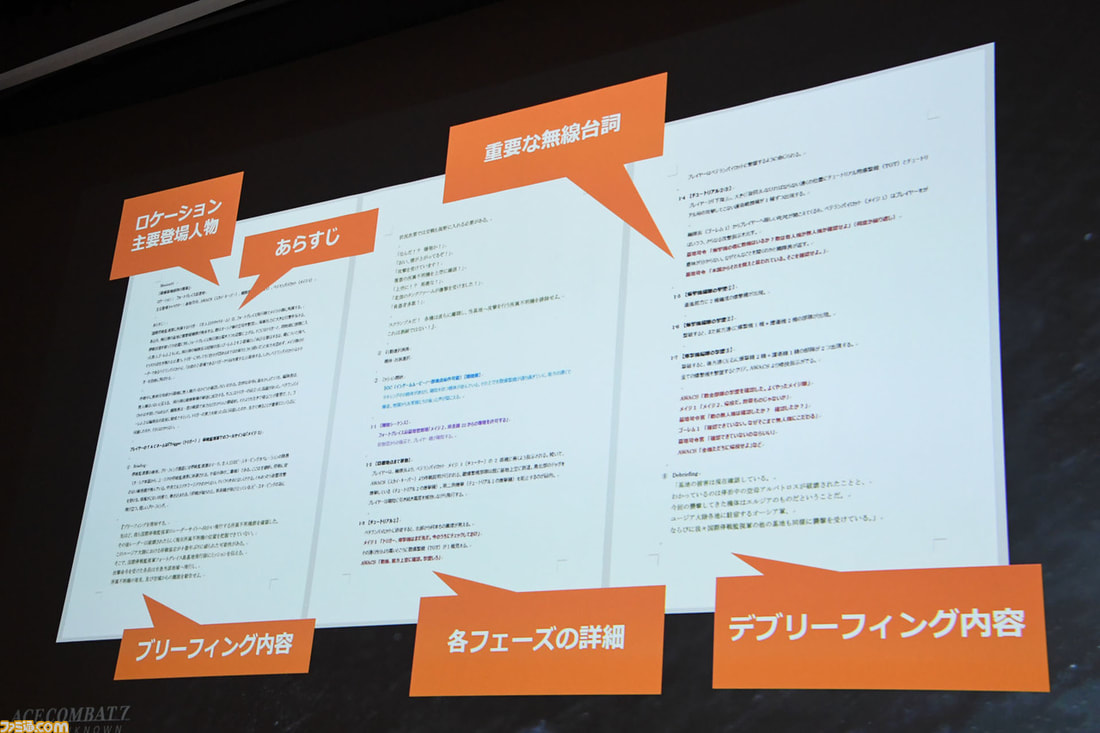 Top left to right:
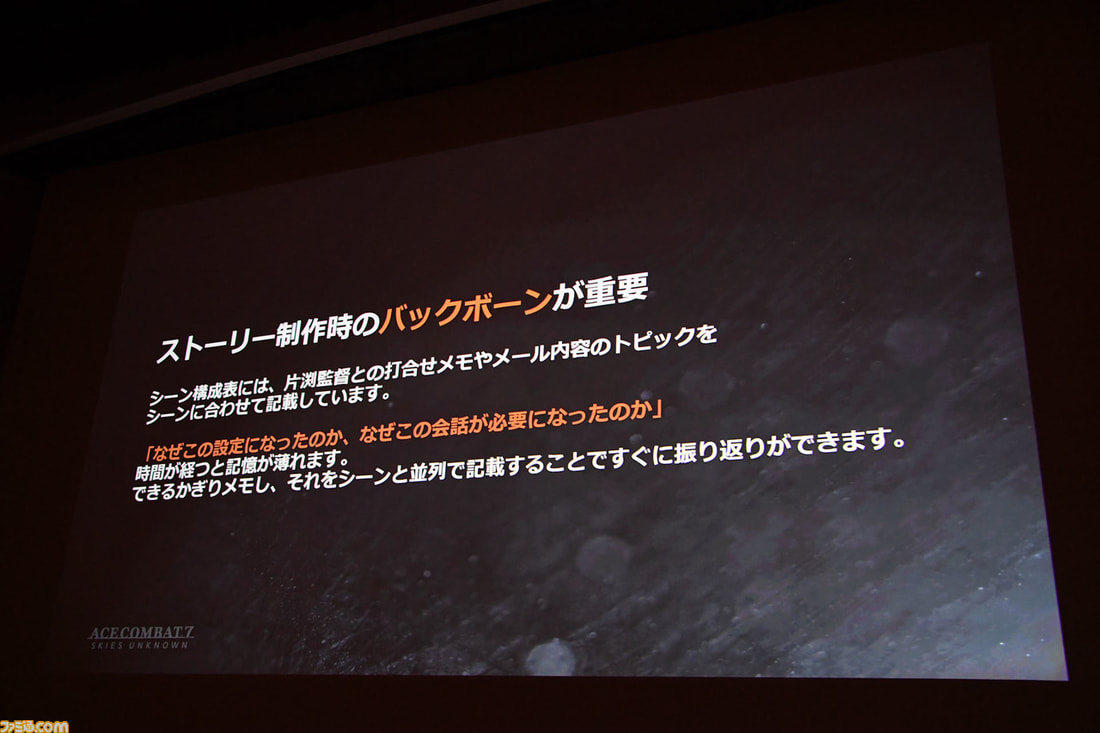 A backbone for the story during development is vital In the scene construction table, notes from meetings with Katabuchi and email content are noted as they relate to the scene. “Why did you have this part like this? Why is this dialog important?” As time passes, recollection will fade. We took as many notes as we could, and by mentioning them alongside the scene, we could see plainly what was originally meant. The third item, pre-visualization, is used so that staff may properly share between themselves things which are difficult to explain in words like radio communication timing and BGM cue timing. In other words, it’s a specification document in video form. Itomi presents Ace Combat’s storytelling like a radio drama. It is a drama formed out of radio conversations, breathing noises, pauses, and environmental sound effects. For things like this, it’s faster to explain the key points by making a video instead of using words. 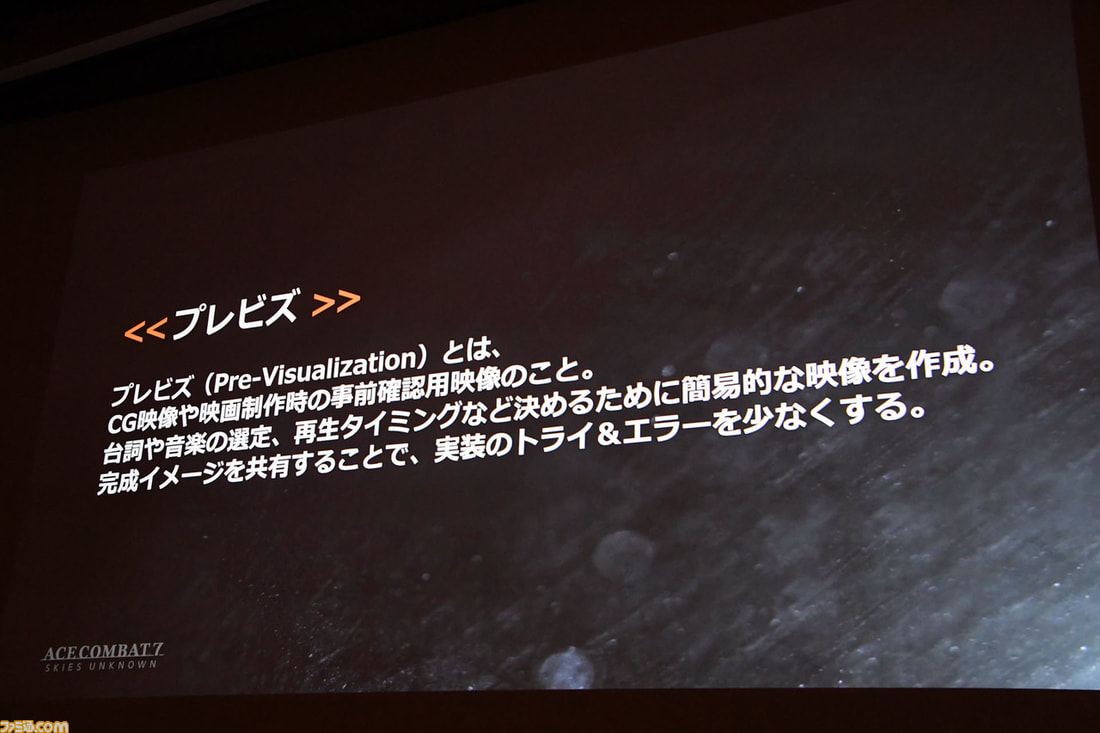 Pre-visualization Previs is a video used to validate concepts during the production of CG video and movies. A simple video is made to determine dialog and music selection, as well as playback timing. By sharing a complete image, trail and error in the actual version is kept to a minimum. 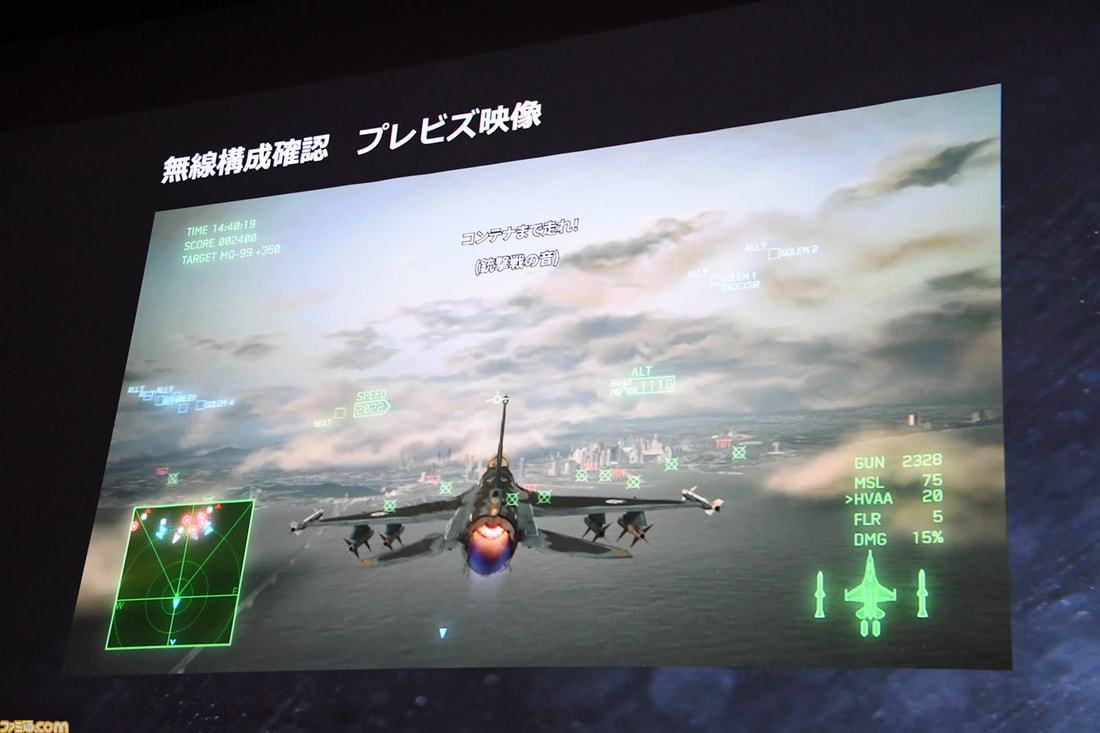 Radio validation previs movie 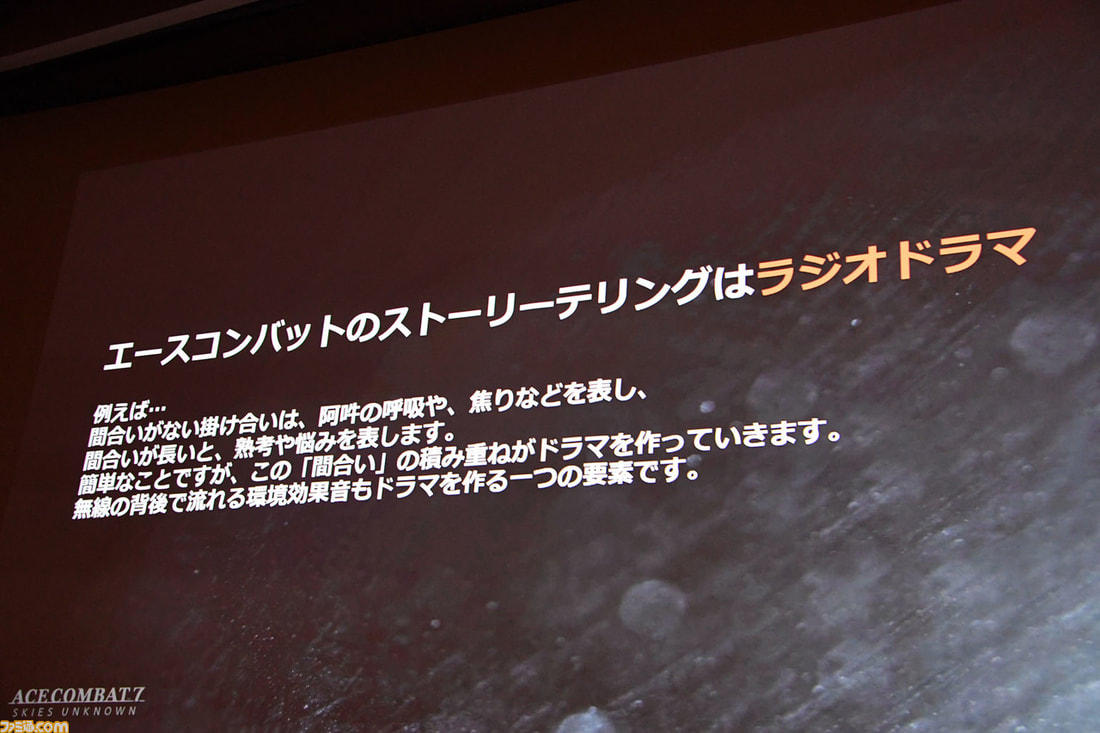 Ace Combat’s storytelling is a radio drama For instance… If a pause is short, it expresses breathlessness and impatience, and if it’s long, it indicates contemplation and holding back emotion. It’s a simple thing, but the chaining together of pauses creates part of the drama. Environmental sound effects going on behind the transmission source are also an important element of creating drama. Here, Itomi gave us an introduction to the concept of dividing music up and determining loop points so that the high points in the music flow naturally with the excitement of the gameplay. [1] The amount of time different players will spend playing any given part of Ace Combat 7 will vary, so they wanted to match the music with how the mission is progressing so as to make the play experience more exciting. How it works is that the track’s B and C melodies are divided into looping parts called “landings” and played back. As the player advances through the mission, once a break point is reached, it proceeds to the D melody. This is to say, climaxes which fit the gameplay are made to loop in a way which feels natural. 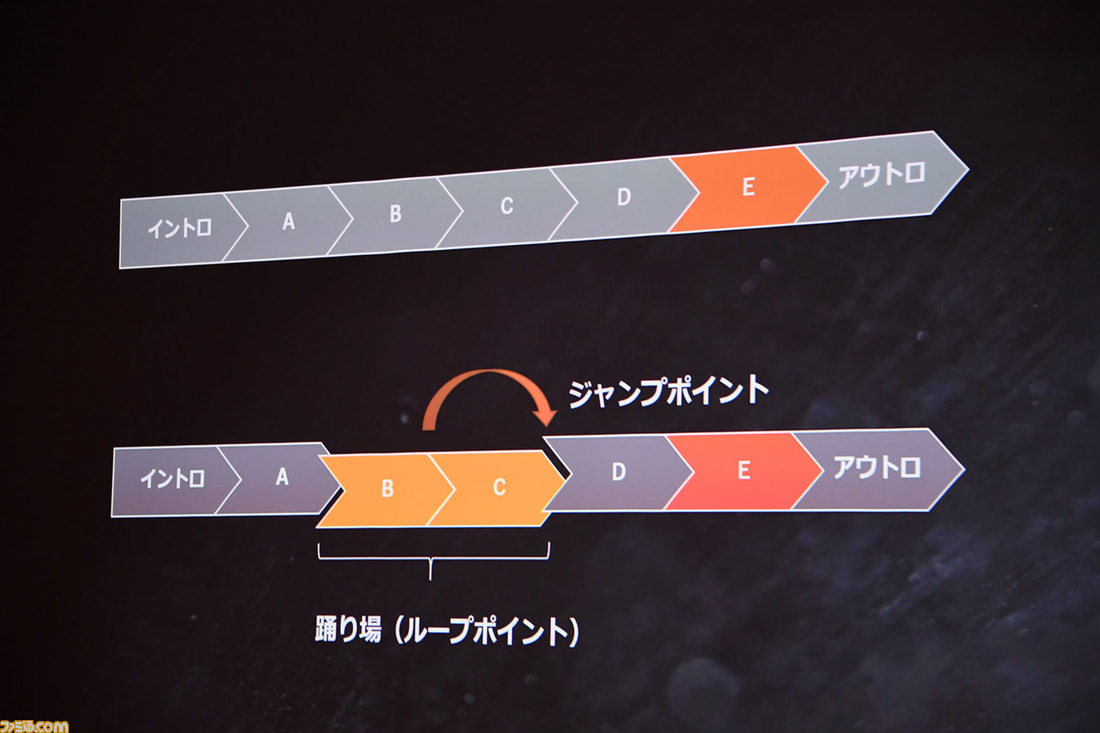 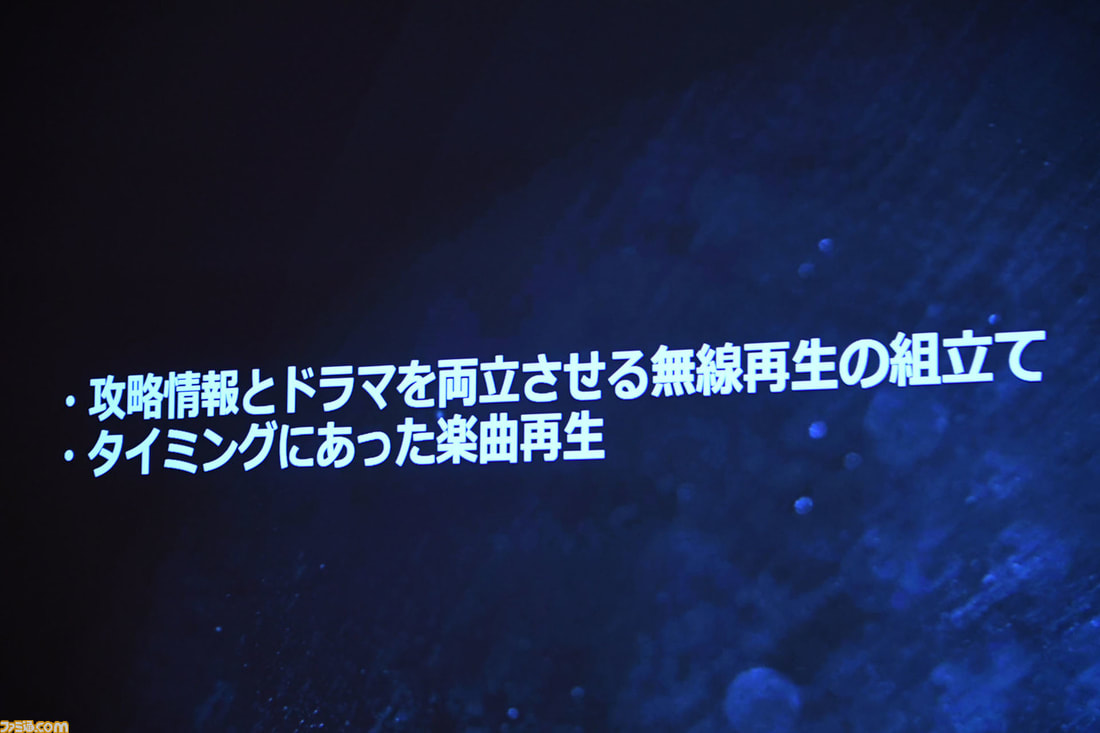
Finally, Itomi talked about how the development information’s “freshness” was important. If feedback to address problems in development comes too late, those problems are dismissed, and they become irreversible. In severe cases, the problem itself can be lost and left as-is. He told us fresh data is valued for that reason, and getting feedback as quickly as possible is important. 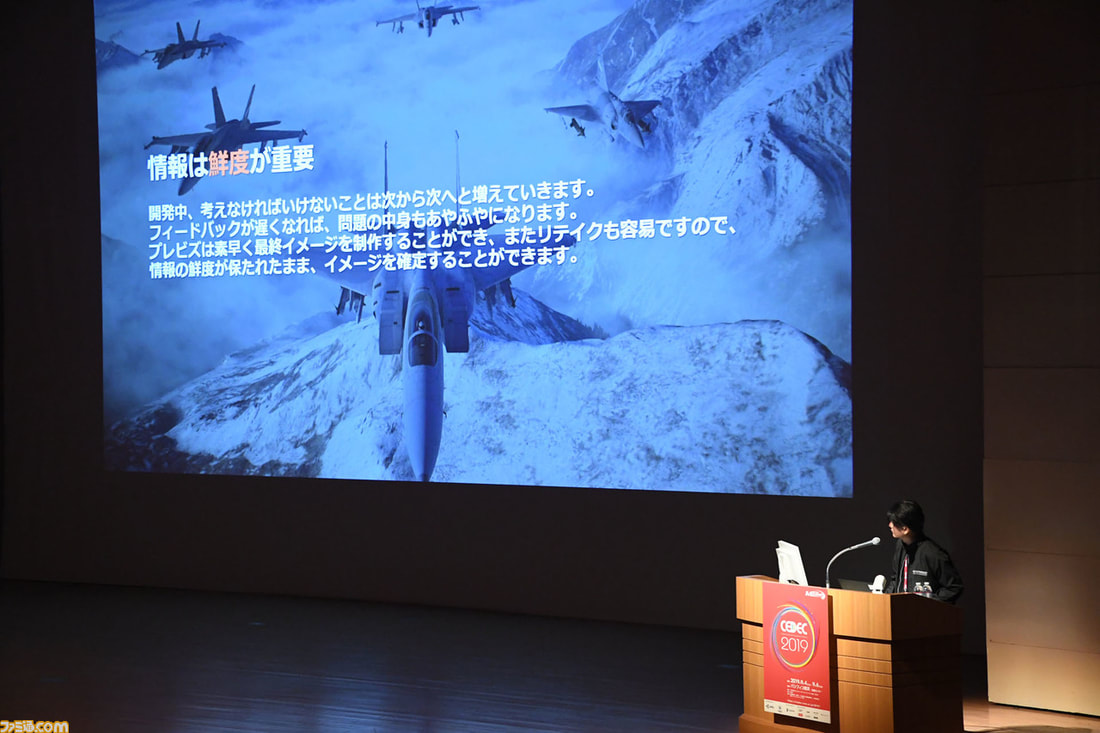 Fresh information is vital During development, there’s always one thing after another that needs looking after. If feedback is late, the scope of a problem becomes frightening. With previs we can quickly arrive at a finished image, and getting retakes is quick and easy, so while information remains fresh, we can validate an image. Ace Combat 7’s radio chatter is mixed into three types and fit to match the gameplay! Masahide Kitou took the stage in the last half. He was in charge of the writing and implementation of the radio dialog. Kitou started by saying that the interactive gameplay, and the text, sounds, and dialog of the story mix like oil and water. As mentioned above, it’s hard to reconcile the fact that different playthroughs will vary in play time – and what state the game will be in at any given moment – with the fixed nature of text and voice. This is called “ludonarrative dissonance:” the situation when the gameplay and the story are out of harmony.  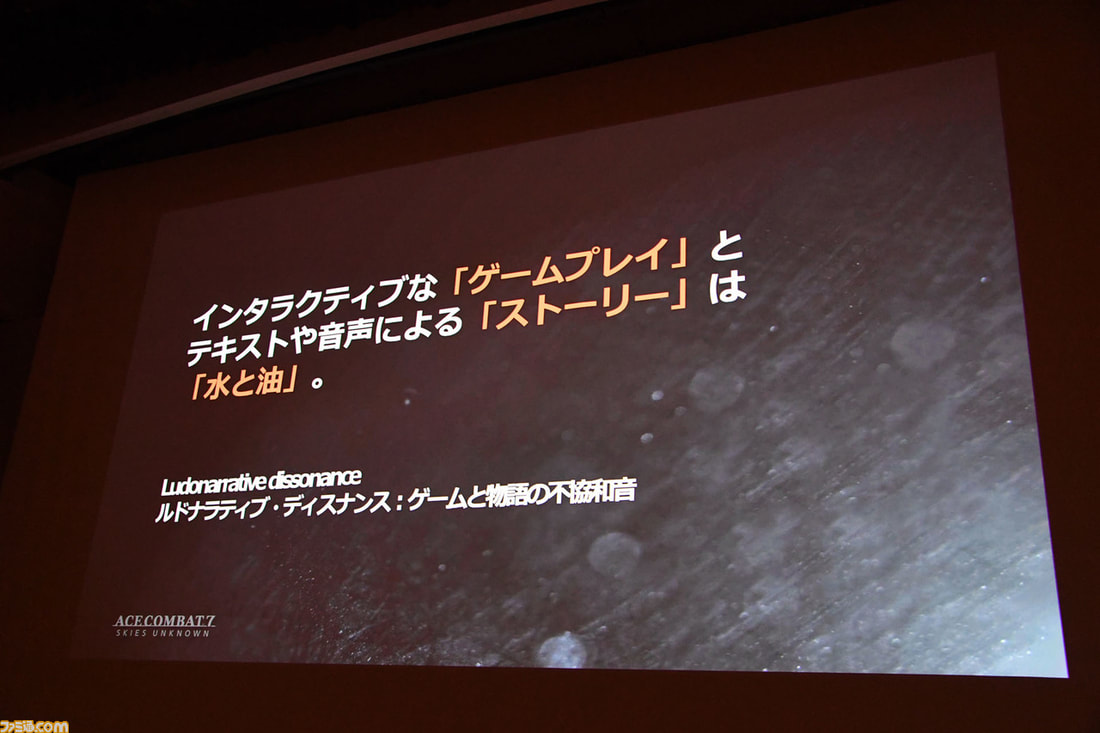 Interactive gameplay mix with the text and voices of the story like oil and water Ludonarrative dissonance: the state of dissonance between game and story Ace Combat 7 has three types of radio dialog in order to adapt to the troublesome nature of interactive gameplay. They are “situational transmissions,” “greek chorus transmissions,” and “strategic transmissions.” Of these, situational transmissions play in reaction to player actions. They’re feedback to gameplay, and increase the sense that the game is responsive to the player. Greek chorus transmissions are, to name an example, things that might play when the player is in a particular map and the enemy forces fall below 70%. They’re transmissions which play when certain conditions are met. They create a sense of atmosphere in the battle space. Strategic transmissions are the kind of thing that might play when the player destroys a particular target. They’re transmissions that tell the player about plot points when they get to them, and help develop the story. 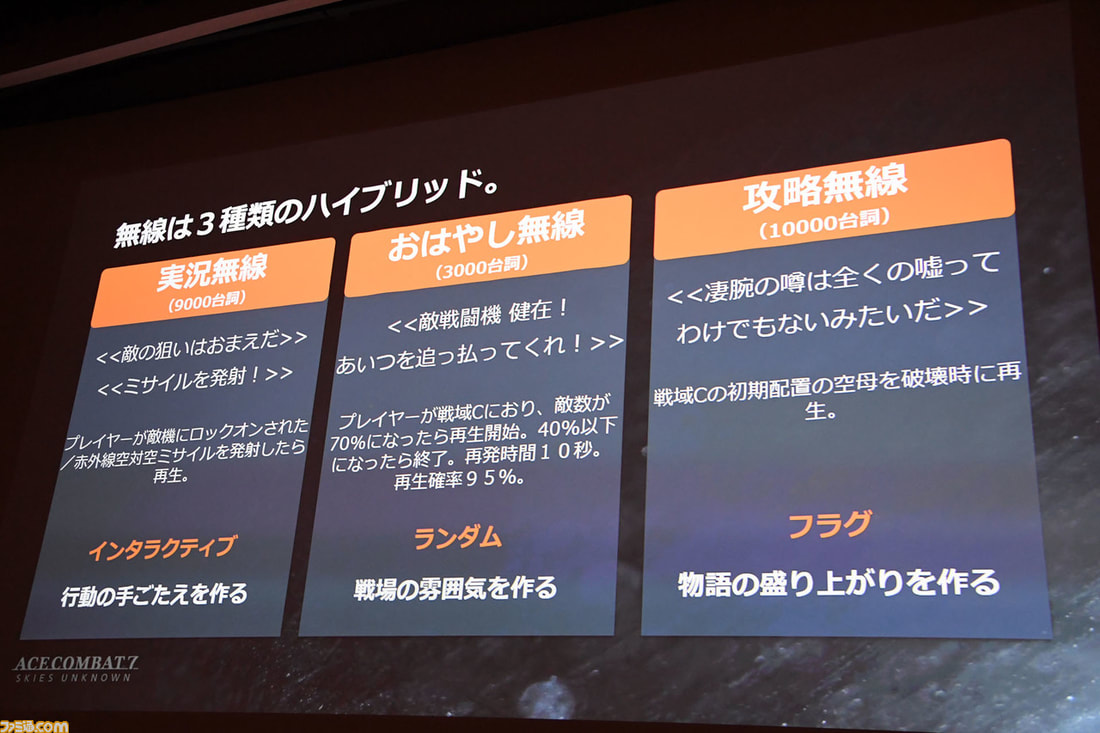 All radio transmissions are divided in three types.
With these three types of radio transmission, the play experience and story progression can be complemented by natural radio chatter even during fluid mid-mission gameplay. All these things are controlled by the RadioTable and the queue. The RadioTable is where radio chatter which might play during a mission is collated. For this lecture, it was put in an Excel-like table to make it easy to grasp. Transmissions which play in response to gameplay are entered into a queue and wait in order to be played. However, each transmission has various parameters for playback appended on the RadioTable. First of all is Priority, which moves items up the queue in relation to their importance. Next is QueueLimitLife. Voice lines in the queue waiting to be played whose queue lifespan has expired are removed. For instance, if you shoot down an enemy plane, but a voice line with higher priority is playing, if too much time elapses since you’ve shot it down by the time the line ends, it wouldn’t be natural for there to be a “bandit down!” line anymore. Items are given a lifespan so that this never happens. Additionally, there’s a RequeueingWaitTime. This is a parameter by which once something has played once, it won’t enter the queue again for a specified interval. It’s unnatural if the same transmission plays non-stop, and this guards against that. The odd man out is the StartDelay parameter. Voices wait a specified amount of time before playing. By putting these delays in the radio exchanges, one may read contemplative pauses and restrained emotions into the conversation. For instance, you can see a glimpse of a squadron member’s chagrin by the delay of her reply after being bested by her captain. This is the kind of affect you can achieve with this parameter. 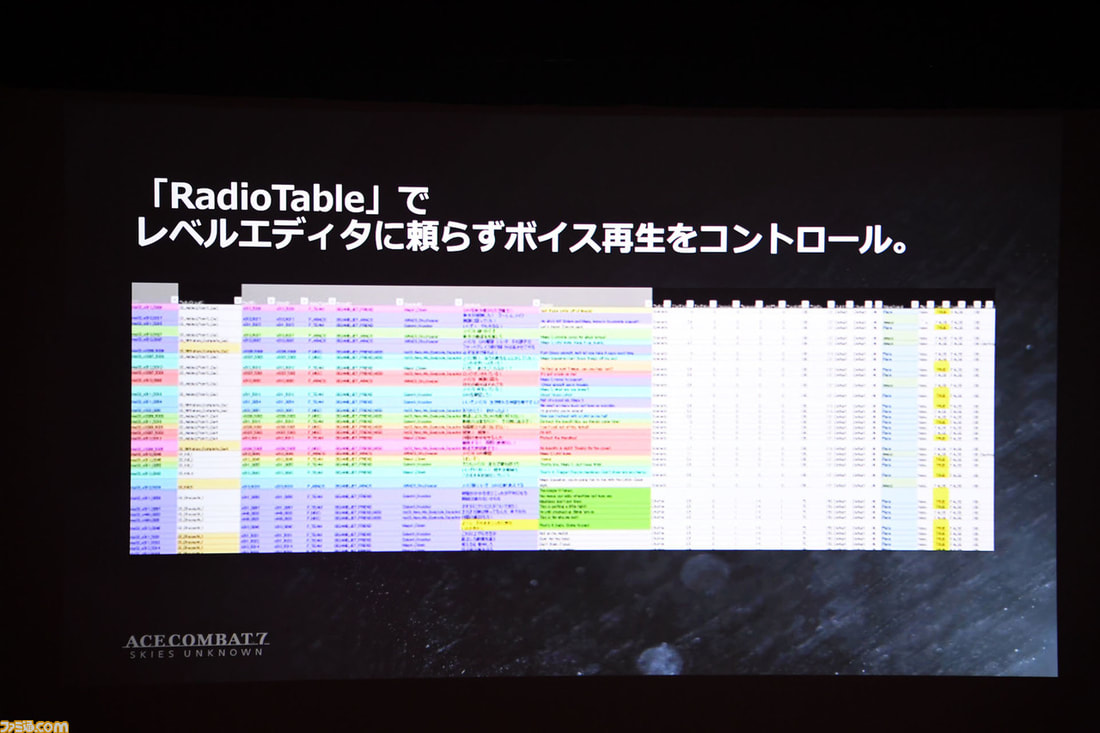 With the RadioTable, we have a control for voice playback without going into the level editor 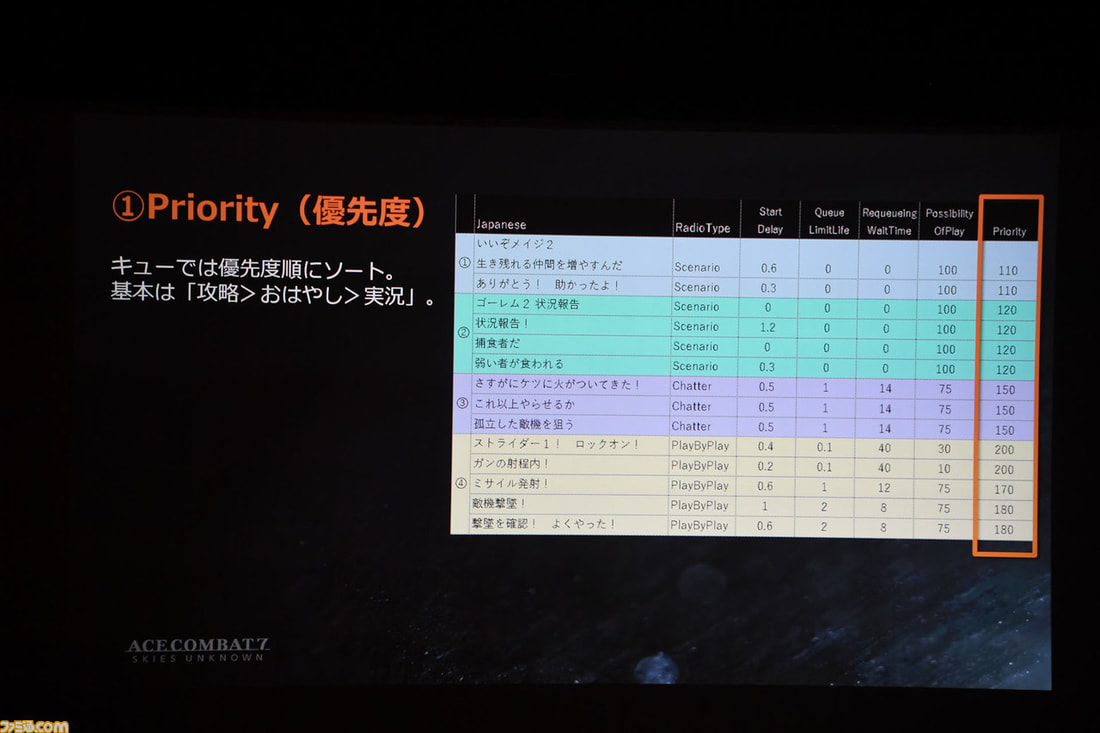 ①Priority Sorts items in the queue according to priority. Generally it’s “Strategic > Greek Chorus > Situational” 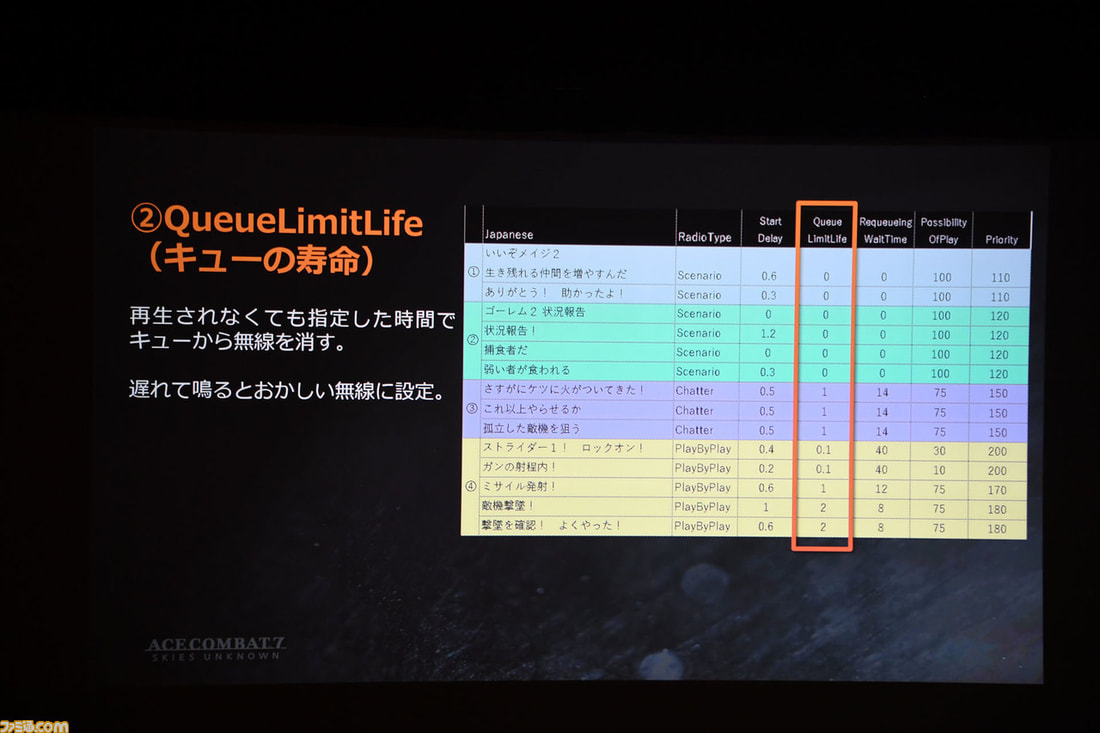 ②QueueLimitLife Transmissions are removed from the queue at a specified time after having been triggered to play. Given to transmissions which would be weird if delayed too long. 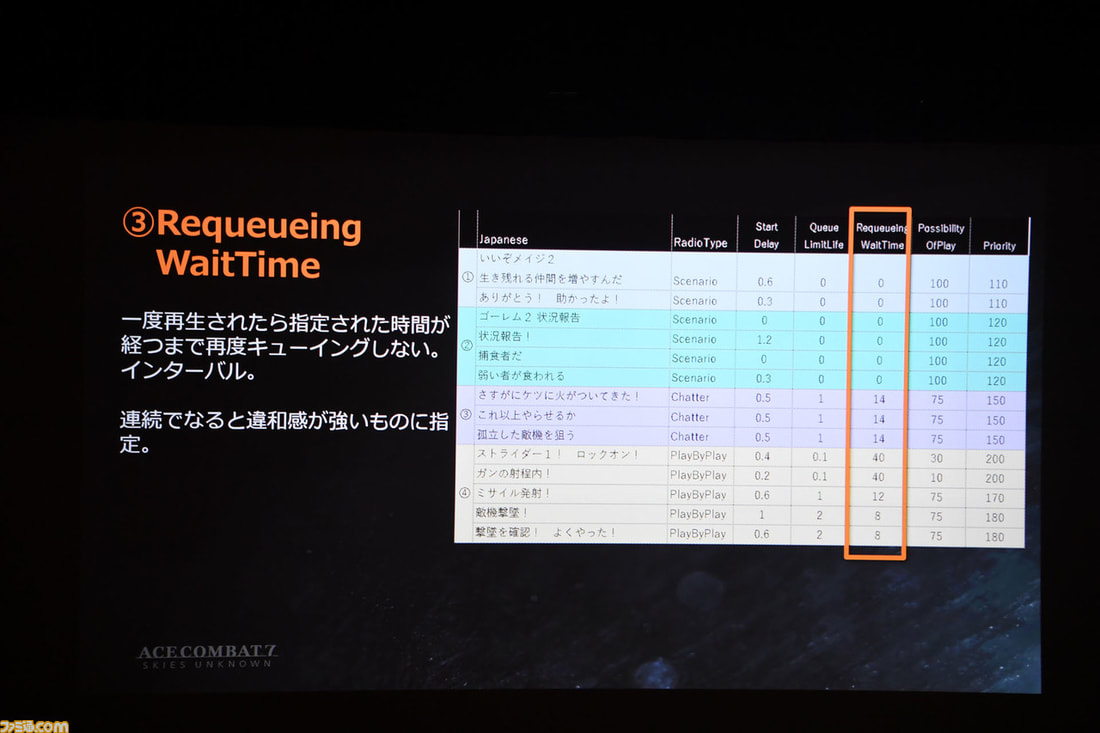 ③RequeueingWaitTime After having played once, an item won’t enter the play queue until a specified amount of time has elapsed. Interval. Given to items which would be disconcerting if they played continuously. 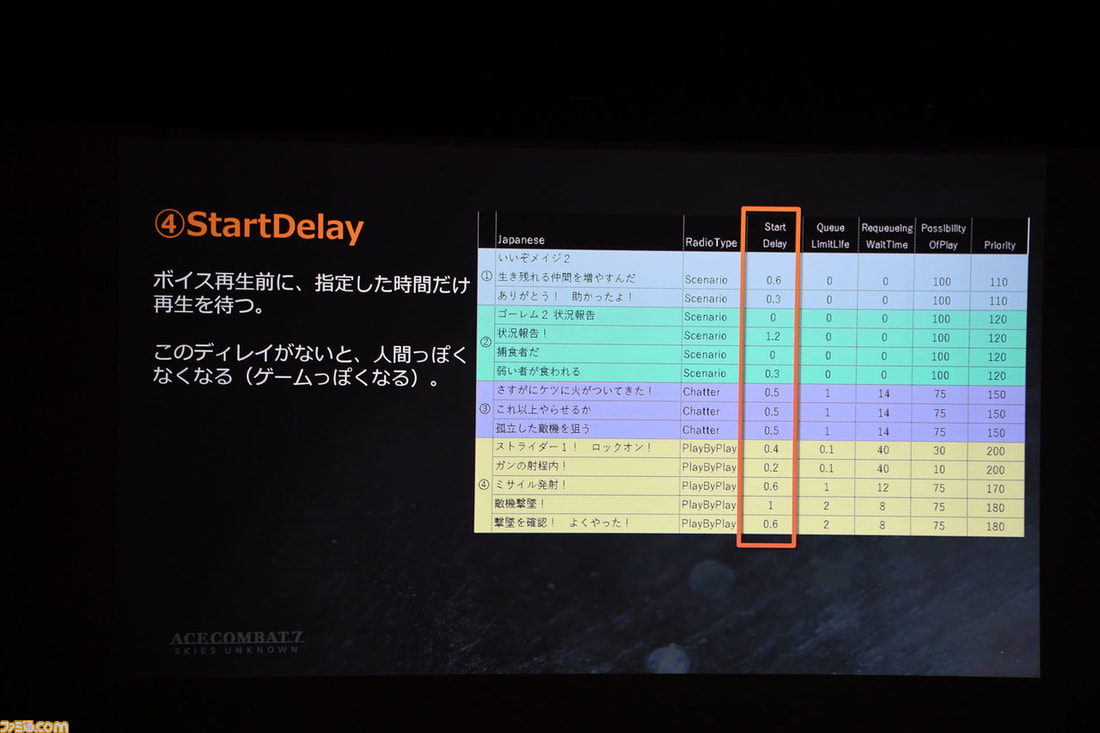 ⑤StartDelay Wait a certain amount of time before voice playback. If there isn’t this delay, the characters would seem less human (and more like a game) 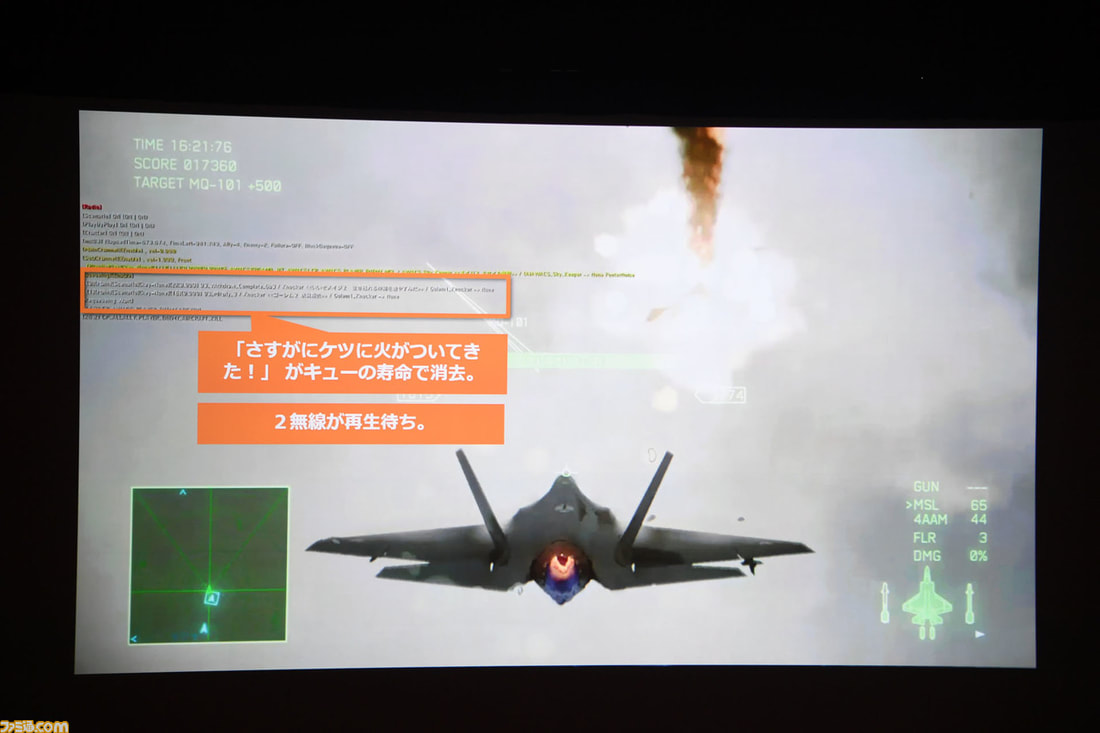 “Oh yeah, his ass is burning alright!” Has been removed from the queue due to hitting its lifespan. Two transmissions are awaiting playback. The three types of the Ace Combat series’ indispensable radio dialog are managed in their various aspects by assigning different parameters, created so that the fluid gameplay mixes naturally. Kitou refers to managing the transmissions combined all together and mixed within the queue as “stirring.” Once combined and emulsified, the oil and water of gameplay and story will mix. If mixed adeptly using these concepts, game and narrative will play in concert. On that note, the presentation concluded.
1 Comment
 The other half of 4Gamer's Ace Combat 7 coverage from TGS 2017 has landed, and it's…well, the same single player demo that we've already seen plenty of coverage on. Nonetheless it's a short article with one or two new fragments of insight, so there's nothing lost in summarizing it.
I wonder if some of the same behavior used for clouds will also be applied to jammer pods. That could provide an interesting dimension - maybe even make the things useful. As always, you can get in touch either in the comments or in our Discord if you have any questions.  Ace Combat 7 appeared at TGS 2017! The coverage has slowly been rolling out in the Japanese gaming press, and now we have another interview between 4Gamer and brand producer Kazutoki Kono. This one is mostly about plot, which we figure may be something our audience is curious about.
That's about it, folks! The game Kono paints in all his interviews seems very ambitious, both structurally and thematically. I'm very curious to see how his team will execute on all these ideas. It'd be nice if they put some fluff material on the official site, but at this point we may well simply be waiting until the game is out. Of course if they do post anything, you'll hear about it from us. Feel free to hit us up in our Discord or the comments if you have any questions.  Hello everyone! First up, NamDai decided to release a new trailer for Ace Combat 7 at Gamescom. There's little new material in it, but it still provides some food for thought. We're not the kind of blog that does gameplay, plot, or visual analysis, but there's a few things about the localization that deserve clarification and discussion. "Spare 8! Do not engage the enemy!" A fine line that lost a bit of data in English. In the Japanese, they forbid Spare 8 from getting into a dogfight with the Flanker, rather than exhorting him not to engage. The result for Spare 8 is the same, but the nuance is different, since it implies that the reason AWACS doesn't want the Super Bug to engage is because the "experimental" Flanker is especially dangerous in a knife fight, and not for some other reason. "…clearly an illegal and unforgivable violation of our nation's sovereignty." Maybe there just wasn't enough space to put the whole line in subtitles, but that entire clause is gone. Japanese Cosette simply says that "the great power Osea encroaches on us from overseas, building a titanic orbital elevator within our sovereign territory." I guess we'll see whether it's a trailer-specific quirk or whether the localization team was being bombastic again. "Concentrate on him! Shoot him down!" -was in Japanese "Get that guy! We can turn it around if we get that one plane!" The English lines in this trailer aren't so bad, but they do seem to diverge in ways which are at least mildly important. So long as the final product is good, I think us fans can forgive a few liberties beyond what's needed for good flow here and there, but I hope they're being careful. As you'll see, translating Sunao Katabuchi's work isn't something to be taken lightly. 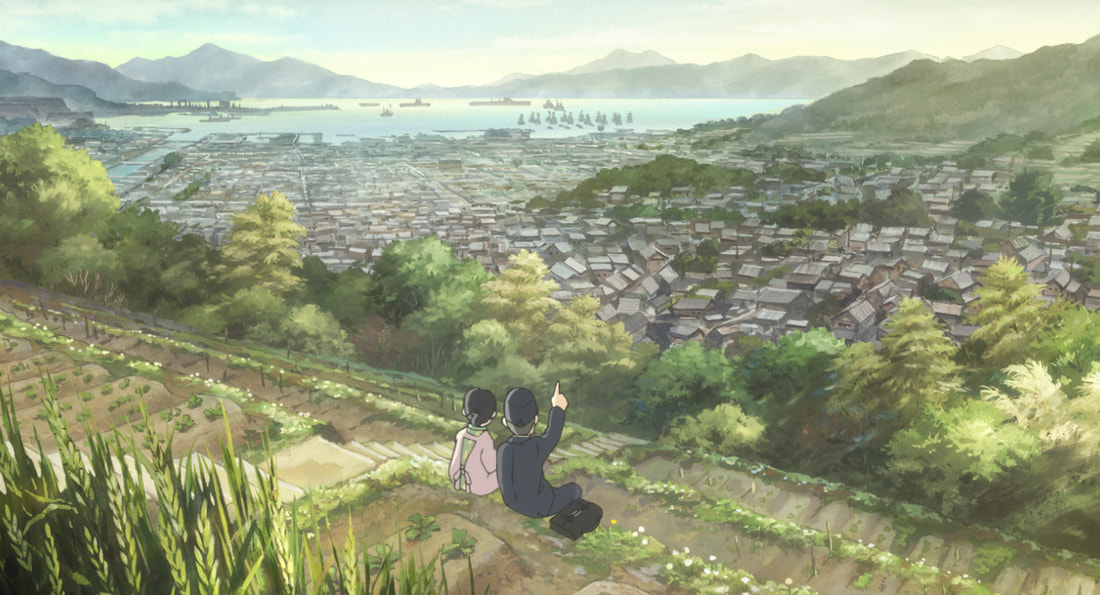 Sunao Katabuchi recently wrote and directed a wonderful film called In This Corner of the World. It's about the life of a young, newly wedded woman named Suzu Hojo (nee. Urano) in the town of Kure - a major Japanese military port in the Hiroshima prefecture - during the final days of World War Two. It's a simple story of a woman and her extended family told as realistically as possible, with no desire to shock or impress. No more, no less.
With realism as its main goal, it's also an honest examination of the effects the war had on the daily lives and attitudes of the people who lived then. Suzu takes a lot of pride in continuing to live her life as the American bombing campaign continues, seeing the surrender as "giving in to violence," even as the movie makes clear that the war is hopeless and brings only needless suffering. Earlier, Suzu takes cover with her father-in-law Entaro and her young niece Harumi during an American carrier strike against ships in the harbor. Entaro points to an N1K-J Shiden dogfighting an American plane, and expresses his pride in having worked to increase the output of the Nakajima Homare engine powering it to 2000hp. Young Harumi struggles to scream over the engine noise and explosions, "what about the American engines?" The noise consumes her question. As you might guess, there's a certain thematic through-line between In This Corner of the World and Ace Combat 04, which IGN JP asked Katabuchi about in a November 2016 interview: – What were the circumstances that led you to be involved with the Ace Combat series? The people in Namco’s Ace Combat team knew Eiko Tanaka (representative of Studio 4ºC, which produced Princess Arete), and this led to talk of whether or not to have them make the in-game images. When Tanaka heard it was a fighter game, he decided to come and talk with them together, and I get the sense that's where they hammered things out. It was either after the first screening or when we were dubbing Arete, but the very next day I was off to go see a Japanese Navy airstrip in Yokosuka. – I guess that was your disposition for painstaking research at play. What kind of tone does Ace Combat 04: Shattered Sky [sic] (released in 2001) have, being made in that manner? Ace Combat 04 is a close up of an ace pilot in the jet age. I knew I wanted to make a story like those you find in military aviation history, so following from that he’d have to be like this, and like that, and when it all came together I figured I could make him the so-called “final boss.” And yet, I wanted to make him a sympathetic person in the highest degree. That’s not really something done in games. But it’s war, after all. Isn’t it a good thing for there to be life in the opponent you’re taking down, and to make the moment when you defeat the strongest foe a sad one for the player? That’s how I thought of it. – It felt very fresh at the time. Maybe it’s because I did it without knowing anything about games. Is it really okay to have an enemy pilot, create a neighborhood, have a young boy and girl protagonist become involved, and then have this person appear as the last boss to be taken out? I was torn, but I decided it’d be for the best. Hayao Miyazaki often draws people who fly, but Ace Combat 04 had a ground level perspective: a boy who lost his family when a destroyed plane crashed into his house. This boy can only look up at the sky. Suzu doesn’t fly herself in In This Corner of the World either. She’s the kind of person who doesn’t even fly in dreams or fantasies. The sky above her is where horrors come from. Maybe there’s a direct line from Ace Combat to this depiction. I think people who play Ace Combat will understand.  We've decided that doing summaries of interviews instead of complete translations is more efficient - both for you the reader and for us. It means we can get information out more quickly and you don't have to rely on google as much. So to start off, we've summarized…an interview which BlackKite2128 over at r/acecombat has already summarized quite well! Auspicious. But we're sure not going to complain about more Japanese speakers active in Ace Combat circles. Here's the points that stuck out to us.
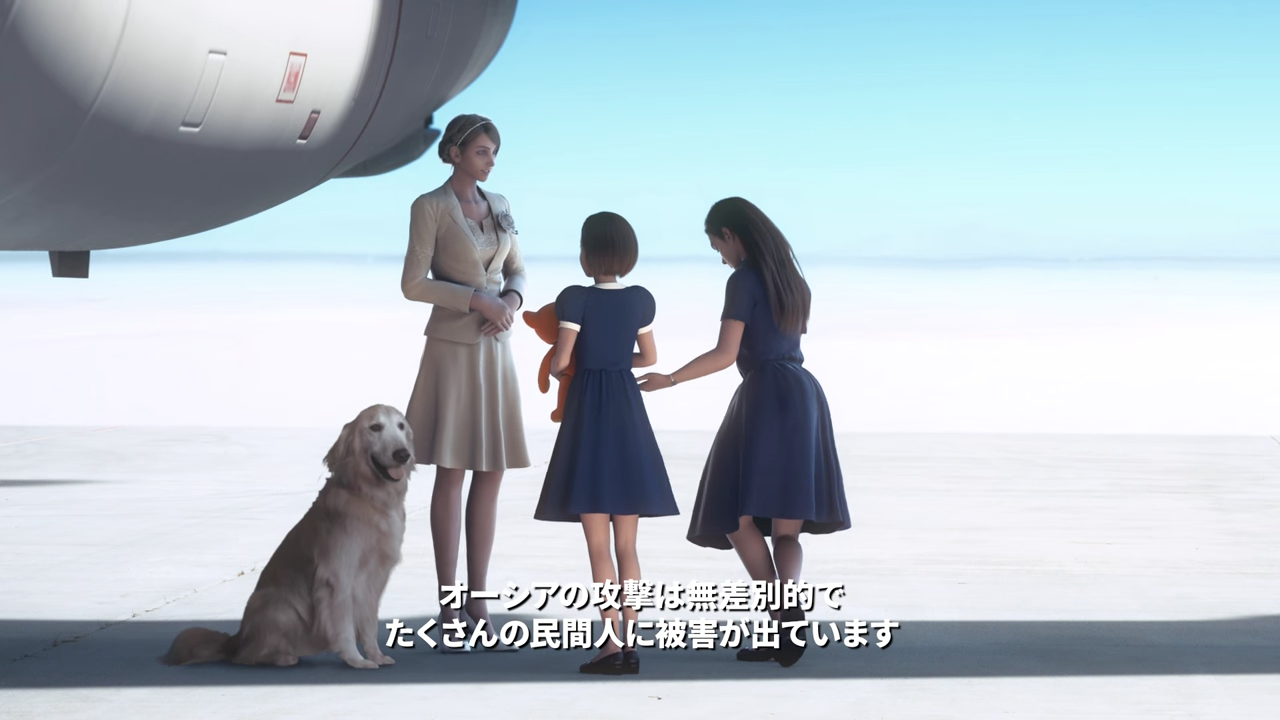 Since part of the reason this site exists is as a repository for Japanese language Ace Combat material, Zaku’s letting me use the blog to post translation-related stuff about AC7. First up, a translation of the interview segment of this Famitsu article. The writeup on the first page is pretty much just a walkthrough of the demo, which we’ve all seen for ourselves, and will eventually get to experience for ourselves anyway. The interview with Kazutoki “key man” Kono following it is much more revealing. A rabid obsession with the sky A new PV and playable campaign mode demo for the project were exhibited at E3 2017. What were the contents of the PV and playable demo like? Being curious we put a few questions to the key man behind the project, Mr. Kazutoki Kono. What goes into bringing “innovation in the skies” ——The release date has been pushed back to 2018. To start off, could you tell us a bit about why? Kono: I would like to offer my sincere apologies to all our fans for making them wait. We are continuing development around the concept of “innovation in the skies.” We released a build for E3, and things are taking longer than expected due to brush up work and concept implementation. We believed it would show ingratitude towards all the fans who have supported us for so long to push ourselves to get it out the door unpolished in 2017, so we decided to push back the release date. ——Are partial PS VR support and attempting so many series firsts some of the reasons why? Kono: PS VR support is a challenging aspect, but this project is not VR exclusive content. In order to further raise the quality of the main part, there are so many things we have to adjust, and… For instance, what kind of tactics will arise when an enemy enters a cloud? How should being in a cloud effect missiles and radar and stuff? Introducing just one element increases the amount of stuff you’ve got to think about like crazy. I can take a practical tact towards the game and do away with some things too, but bringing the idea of “innovation in the skies” home is eating up development time like you wouldn’t believe. ——But I think that the defining characteristic of the Ace Combat series isn’t the pursuit of realism, but rather its accessibility as a game. Are you worried about that as well? Kono: If we were to pursue simulator elements and physics 100%, the game would become entirely too difficult, and it wouldn’t feel right. It’s necessary to find an Ace Combat-like balance - an entertaining lie. Bringing home the experience of how great it feels to be immersed in a story within this balance and becoming an ace pilot is what we’re pursuing in development. ——I played the version exhibited at E3, and I noticed a few things which have evolved. In particular, the water droplets on the canopy moved. Kono: The representation of water droplets was very popular with the developmental staff too. Water droplets form on your canopy and then freeze when you enter a cloud, which besides being very pretty and immersive, gives you a sense of the temperature and texture on the inside of the cloud, which is something we’re very proud of. ——I got the feeling of the cloud’s thickness and temperature. Kono: This is just my personal obsession, but my rule for this game is not to merely represent things with objects, but for you to be able to grasp the situation just by looking around. If you’re able to judge a cloud’s qualities by looking at it - like that if you’ll run away into a cloud you’ll be safe, or on the other hand if the clouds are thin it’ll be dangerous - you’ll be able to turn this into fighter tactics. If we represented “this cloud’s thickness is 70%” with a gauge, it’ll become a game about minding your status instead of keeping awareness of your surroundings, so I made this a goal for the game besides visual realism. ——The way the radar went blurry and giant shadows appeared when the Arsenal Bird entered a cloud was impressive. Kono: How things will ultimately be represented, even including whether the radar will go blurry or not, is still in the midst of brushup work. Should the effect on radar when you enter a cloud be to go blurry? Does that work? Does it stand up to my rule? I’m always thinking about this stuff. I said this before, but with every single thing we implement, I have to follow the same thought pattern: what will its impact be on the game? On tactics? On my rule? Like, “what happens when a stealth plane enters a cloud?” Can you handle both with blurriness? When making adjustments, and when we’re in a situation where we’re wondering which would look best to our customers, we have a conviction to find what’s most intuitive by reference to the rule. ——UAVs (unmanned aircraft) figure in this project in a serious way, so do you have similar convictions about UAVs? Kono: UAVs also figured in Infinity, but if I can speak in due candor, we have a ways to go with “UAV-ness.” We’re delving pretty deep with this project. We’re still figuring out how to represent it, but they can fly in ways manned aircraft can’t, they sacrifice themselves to defend their target…I tell my staff “Think how an AI would feel! What would you do if you were an AI?,” which is really just an inscrutable thing to say. To the game, everything is an AI. (laughs) Furthermore there’s an element of contrast in the story between the UAVs and the F-104, once said to be “the last of the manned fighters.” This isn’t limited to Ace Combat, but I’m of the opinion that there’s a lot to think about in that contrast, so that’s something you can look forward to. Clarifications about some of the story and characters!? ——What are the highlights of the trailer first shown at E3? Kono: There’s new information in the E3 trailer. It touches on story elements and character names which have been hazy up till now. Like the Erusean Princess Cosette. We included scenes like that one and the appearance of the aircraft carrier “Kestrel II” that would put a smile on the faces of series fans. Besides that, a place named Farbanti from 04 was in there as well. We coined the term “Strangereal World” when we were making the world of 04 using improper English grammar, but coin it we did. From that point on, for whatever reason, it’s become established to users around the world as “Strangereal.” For that reason, “True Strangereal” (laughs) is what we call the world based on 04 from which the numbered titles have stemmed. Of course, the strength of that backbone is a tool to give birth to drama, so we’re making it such that newcomers can go “I want to immerse myself in the sky’s beauty,” and experience the intricate drama of the story and go “this is really meaningful,” even if they’ve never played Ace Combat before, so by all means you should check it out. ——The scene of the two countries fighting around the orbital elevator was impressive. Kono: Erusea has occupied the orbital elevator in the current trailer. However, soon afterwards Erusea issues a claim with Princess Cosette’s saying “Osea’s attacks are indiscriminate.” One of the themes of this project’s story are the Ocean and Erusean claims and how they contrast. It’s the same war, but if you change what side you view it from, your interpretation changes as well. I look forward to hearing how people feel about the story of this one, listening to each country’s messages. The truths of all the main characters are as a mirror reflecting your own appearance. The truth is that contrast is a theme we’ve already done, so the core theme of this one is “reflection.” This is the theme which the PV sets up. ——The theme seems to be hidden in the project’s subtitle too… Kono: “Skies Unknown” huh. Of course it reflects the story and themes, but simply put, it’s a more evocative image to have it as “Skies Unknown” and not “Unknown Skies.” There’s other meaning in it, but I can’t talk about it. (coy smile) ——I look forward to a followup report! Will there be an opportunity for Japanese fans to try it for themselves in the future? Kono: I can’t announce anything concrete, but I’d like to hold an event where Japanese fans can experience it. We’d talked about it a bit earlier, but we’re designing it so even inexperienced people can fully enjoy it. Stay tuned for more info. We’ll explain details of the story and other deeper part later. Furthermore, there will be an article in June 29 2017 issue of Weekly Famitsu (release date 6/15) as well, so check it out. We are lucky that Kono is the kind of guy that rambles off on his own without the interviewer prompting him. He doesn’t have the kind of immunity from his superiors a famous auteur like Hideo Kojima has, but the degree to which he’ll talk about production problems and philosophy is greater than you usually see from a Japanese developer giving a promotional interview.
Anyway, there are a few lines in the E3 2017 trailer which have sparked discussion. I’m not about to go casting aspersions on the localization team, but I think it’s safe to say some elements of the localization are…curious…and deserve clarification. “…and the Kestrel II warship.” From 00:33 in the trailer, a news anchor says that the Oseans launched an attack from “their aircraft carrier and the Kestrel II warship.” Or maybe they say “in the Kestrel II warship.” Either way, it’s a strange line. In their version of the trailer, the Japanese subtitles read “Naval aircraft from the Osean Navy carrier Kestrel II have commenced attacks against the capital city Farbanti.” If I had to speculate, I would say that this was a voice actor ad-libbing to fit the lip synch, but that would presume things about the state of the production which we can’t know. "…remorsefully injured…” Princess Cosette tells us in English that the Osean attacks have “remorsefully injured countless innocents,” but regrettably, the Japanese speaking Oseans feel no such remorse. The Japanese subtitles for that line (00:52) read “This is Princess Rosa Cosette d’Elisse. The Osean attacks have indiscriminately brought harm to many civilians.” I leave it to the reader to decide whether this is an esoteric but canonical use of the word “remorseful,” or whether the voice actor simply stumbled over their line and they kept it. “Who cares?” At 01:01, a man says “who cares” about who started the conflict. This is a fair sentiment, but his Japanese counterpart is more reserved, merely stating that “it’s unclear.” We may not know who this character is, but the localization is already changing his personality. There are a few other more nitpicky items - “Erusean forces” are occupying the space elevator, not specifically the air force - but those are chaff. These are the three lines someone looking askance at the localization should care about. We'll see how all this bears out as the game matures. If we learn anything else, you'll read about it here. |